The outdoor couch file
An outdoor couch fails a set-down drink in more ways than an indoor sofa ever has to: a cushion that never sits still, an arm with no flat spot on it, a floor engineered to shed water instead of hold anything level. None of that is bad furniture; it's furniture doing its actual job. Here's what's really happening on each surface out there, why the usual fixes miss the real variable, and what holding a drink steady on a patio actually takes.
"Deep seating" is a defined furniture category, not just a description. Retailers spec it at roughly 22 to 28 inches of seat depth, well past the 18 to 20 inches on a standard dining or accent chair. That extra depth is the point: it's what lets a body sink back and stay there instead of perching at the front edge.
The tradeoff is reach. A table set for a normal chair depth ends up several inches further from wherever a body actually settles on a deep-seat sofa, and nobody does that math consciously. What happens instead is smaller and repeats all evening: reaching for the table stops being a reflex and becomes a small chore, so the drink starts landing on whatever's already under a hand instead — the cushion, the arm, the gap beside a knee.
A rigid tabletop and a set-down drink barely interact; the table doesn't move, so the drink's own shape doesn't matter much. An outdoor cushion breaks that in two ways at once. First, it's soft — typically 4 to 6 inches of reticulated open-cell foam under a solution-dyed acrylic cover, foam built with perforated cell walls so rain drains straight through instead of pooling, which means anything set on top sinks slightly into a surface that keeps re-shaping under it. Second, that surface is domed rather than flat, so a narrow base doesn't even start level; it starts on a slope that gets steeper the moment someone nearby shifts weight.
That's where a container's own proportions decide the outcome. A standard can is short and wide enough to shrug off a small tilt. A sleek 12 oz hard-seltzer can holds the same volume in a taller, narrower shape — about 2.25 inches at the base, just over 6 inches tall — so the same few degrees of tilt a wider can absorbs is enough to walk a seltzer's center of gravity past its own base. Same cushion, same tilt, different result, purely because of the shape doing the balancing.
All-weather wicker is resin woven over an aluminum frame, and most arm tops are crowned or rounded on purpose — flat would collect standing water in a downpour, so the furniture is built with a ridge instead of a shelf. Good design for the furniture, bad news for anything set on top of it, since a flat-bottomed can or glass only ever touches a crowned arm at one high point.
It's also why the clip-on trays sold for exactly this problem keep coming with fine print. Spec sheets for arm-clamp accessories commonly list a minimum arm thickness to bite onto, and one warns outright of a protruding lip below roughly 3/4 inch of arm material — ruling out plenty of woven or tapered arms before the arm's shape even enters into it. Condensation collects in exactly the spot a clamp or a base would need to grip, on a surface that lives outdoors specifically because it doesn't mind the moisture.
Step off the cushion and the ground doesn't get more cooperative. Decking is installed with drainage gaps between boards, typically an eighth to a quarter inch, so a base can straddle a gap instead of resting on solid material. Paver and concrete patios are graded on purpose, commonly around a quarter inch of pitch per foot of run, angled away from the house so rain doesn't pool against the foundation. Both details are invisible standing on the patio, and both mean the same thing at floor level: there's no flat reference plane out here, just a surface built to move water away as efficiently as it can.
Push past the hardscape and it gets less forgiving. Lawn is spongy, root-lumpy, and hides sprinkler heads and shallow dips — exactly the surface that becomes overflow seating on a crowded fire-pit night. A can standing in grass isn't resting on ground; it's resting on whatever root or clump happens to sit under that one spot, invisible again the moment the sun's down.
Every product built for this problem so far has picked a single surface and stopped there. Ground stakes hold a drink upright in soil, which is the one surface an outdoor couch itself never sits on. Clip-on arm holders need a minimum flat width the wicker rarely offers. A folding side table solves the reach problem completely, until wind gets involved — being lightweight and tall is exactly the shape a gust catches best, which is why reviewers praise the heavy versions specifically for not blowing over in a storm.
Even the advice on furniture forums lands on the same workaround: get chairs with wide, flat arms. Houzz threads on fire-pit layouts keep circling back to Adirondack chairs for exactly that reason, since their arms happen to double as a beverage shelf. That's a real answer if the seating around the pit already is Adirondack chairs. It isn't an answer for the sofa, the sectional, or the wicker set already out there. What none of these fixes address is the actual constant: none of these surfaces are flat, and none hold still.
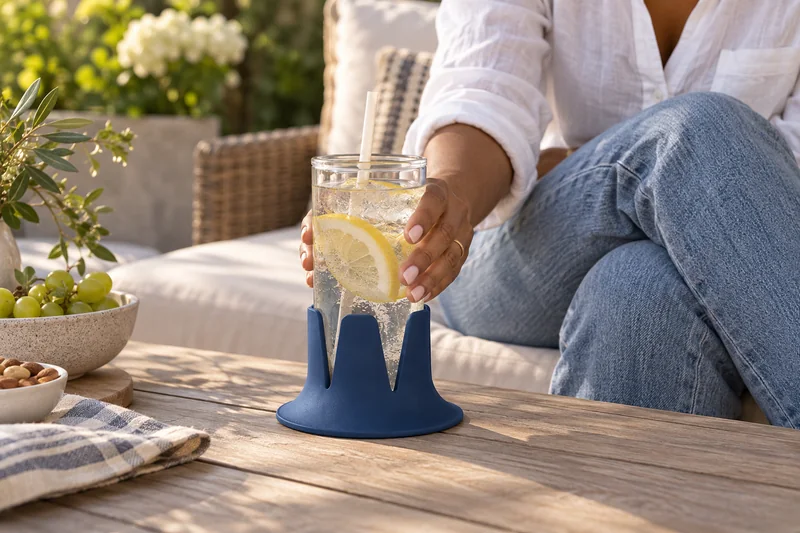
Match the base to the surface instead of asking the surface to be flatter than it is. A wide, flexible base spreads a drink's weight across a domed cushion or a crowned arm as a footprint instead of a single point, so no one high spot does all the work. Flexible fins hold the container by its bottom inch — a grip that doesn't care whether that inch is sweating, cold, or standing on a six-inch seltzer can with a narrow base. A container base of 2 to 3 inches settles in fully, and the fins flex to seat a slightly wider base too, as large as 3.15 inches. Because the base itself is flexible, it re-settles level each time the surface underneath changes shape.
That's the whole mechanism, and it's also its honest limit. It resists tipping across surfaces that were never built to hold a drink level; it doesn't override physics outright. Set it down right — on the cushion, the arm, the gap, or the deck itself — and it holds steady through the kind of everyday shift that would take a bare can or glass down with it.
The outdoor couch was engineered around weather, drainage, and wind — never around where a drink actually goes. Steadi Labs built the base for that specific gap, so the cushion, the arm, and the deck can keep doing the jobs they were already built for.
Grab yours at steadilabs.com →The order completes on steadilabs.com — Steadi Labs' storefront.